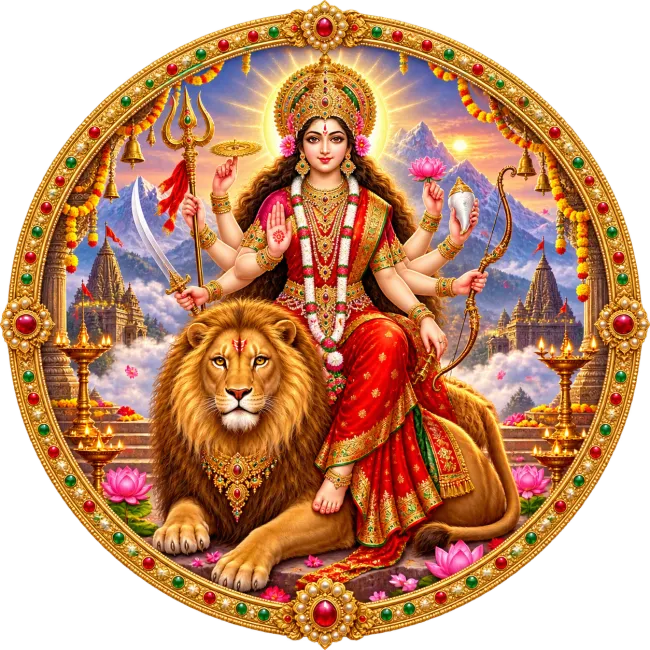
Navratri Ka Mahatva Or Uddeshya
Navratri is one of the most sacred and widely celebrated festivals in Hinduism. It is dedicated to Goddess Durga and her nine divine manifestations, collectively known as Navadurga. The festival continues for nine nights and ten days, with each day devoted to a particular form of the Goddess. These nine forms represent courage, purity, wisdom, compassion, prosperity, devotion, protection, determination, and spiritual awakening. During Navratri, devotees observe fasting, perform daily puja, chant sacred mantras, read Durga Saptashati, light an अखंड ज्योति, and participate in bhajans, Garba, Dandiya, Kanya Pujan, and other religious activities.
The festival symbolizes the victory of divine power over evil forces. It is traditionally associated with Goddess Durga’s victory over the demon Mahishasura, which conveys the message that truth, righteousness, and goodness will always triumph over pride, injustice, and negativity. Navratri is also connected with Lord Rama’s worship of Goddess Durga before his victory over Ravana. The festival concludes with Vijayadashami or Dussehra, representing the ultimate victory of good over evil.
The main purpose of Navratri is spiritual purification and self-transformation. Fasting and worship during these nine days help devotees develop discipline, control their desires, and remove negative qualities such as anger, greed, jealousy, fear, laziness, and ego. Navratri inspires people to awaken the divine energy within themselves and move towards a life filled with positivity, devotion, wisdom, and inner peace. By sincerely worshipping Maa Durga, devotees seek her blessings for protection, health, prosperity, courage, family happiness, and success in life.
Navratri is a significant Hindu festival devoted to the worship of Maa Durga, the supreme manifestation of divine feminine energy or Shakti. The word “Navratri” is formed from two Sanskrit words—“Nav,” meaning nine, and “Ratri,” meaning night. During these nine sacred nights, devotees worship the nine forms of Goddess Durga, known as Shailputri, Brahmacharini, Chandraghanta, Kushmanda, Skandamata, Katyayani, Kalaratri, Mahagauri, and Siddhidatri. Each form of the Goddess carries a unique spiritual meaning and blesses devotees with different virtues and powers.
Navratri celebrates the victory of Goddess Durga over Mahishasura, a powerful demon who represented arrogance, cruelty, ignorance, and uncontrolled desires. According to Hindu tradition, Maa Durga fought against Mahishasura for nine days and defeated him on the tenth day. This victory is celebrated as Vijayadashami. The story teaches that evil and injustice may become powerful for a certain period, but they cannot permanently defeat truth, righteousness, and divine justice.
The deeper purpose of Navratri is to encourage inner purification. The battle between Goddess Durga and Mahishasura can also be understood as the spiritual struggle between positive and negative qualities within every human being. Maa Durga represents courage, wisdom, discipline, purity, compassion, and faith, while Mahishasura represents ego, anger, greed, jealousy, fear, attachment, and ignorance. Therefore, celebrating Navratri means identifying and overcoming the negative tendencies present within ourselves.
Fasting is an important part of Navratri observance. However, its true purpose is not simply to avoid certain foods. Fasting teaches self-control, simplicity, patience, and discipline. By consuming pure satvik food and avoiding intoxicants, non-vegetarian food, anger, dishonesty, and harmful behaviour, devotees try to purify both their bodies and minds. Prayer, meditation, mantra chanting, and devotional reading help individuals turn their attention away from worldly distractions and focus on spiritual development.
The nine nights of Navratri can also be understood as a journey of spiritual transformation. The first three days are traditionally associated with Goddess Durga and the removal of negative qualities. The next three days are devoted to Goddess Lakshmi, who represents prosperity, purity, and abundance. The final three days are associated with Goddess Saraswati, the divine source of wisdom, knowledge, art, and learning. In this way, devotees first remove negativity, then cultivate positive qualities, and finally receive the wisdom required to follow the right path.
Navratri also has great social and cultural importance. Families and communities come together to perform Durga Puja, organise religious gatherings, sing bhajans, play Garba and Dandiya, and participate in charitable activities. These traditions promote unity, happiness, cooperation, and respect for cultural values. In many households, young girls are worshipped during Kanya Pujan because they are considered living manifestations of the Goddess. They are respectfully offered food, gifts, and blessings, highlighting the importance of honouring feminine power.
The festival also reminds society to respect women and recognise their strength, dignity, wisdom, and contribution. Worshipping the Goddess becomes truly meaningful when people show respect and compassion towards women in their everyday lives. Navratri therefore carries not only a religious message but also an important social lesson about equality, dignity, and the protection of women.
From a spiritual perspective, “Ratri” represents rest, silence, and withdrawal from external distractions. The nine nights provide an opportunity to pause, reflect, and reconnect with one’s inner consciousness. Regular worship during Navratri can help calm the mind, strengthen faith, improve concentration, and create a positive spiritual environment in the home. Devotees pray to Maa Durga for protection from difficulties, removal of obstacles, good health, financial stability, family harmony, courage, wisdom, and success.
Navratri is celebrated in different ways across India. In West Bengal and several eastern states, the festival is celebrated as Durga Puja with beautifully decorated pandals and grand worship ceremonies. Gujarat is famous for Garba and Dandiya celebrations. In northern India, devotees observe fasts, organise jagrans, perform Kanya Pujan, and celebrate Ramlila. In southern India, families decorate traditional Golu displays and worship Goddess Lakshmi, Durga, and Saraswati. Although the customs differ, the central message remains the same—the celebration of divine power and the victory of goodness.
The true objective of Navratri is to awaken the Shakti that exists within every person. This inner power gives individuals the courage to face challenges, resist wrongdoing, overcome weaknesses, and live according to truth and righteousness. The festival encourages devotees to replace fear with faith, anger with patience, greed with generosity, ego with humility, and ignorance with wisdom.
Har Ghar Pandit Ji advises devotees to observe Navratri with purity of thought, sincere faith, and disciplined conduct. Along with fasting and performing rituals, one should speak kindly, help people in need, respect women and elders, avoid unnecessary conflicts, and maintain a peaceful atmosphere at home. Even devotees who cannot observe a complete fast can receive the blessings of Maa Durga by offering sincere prayers, chanting her mantras, performing charitable acts, and following a pure and honest lifestyle.
Therefore, Navratri is not merely a festival of rituals and celebrations; it is a sacred opportunity for self-examination, purification, devotion, and spiritual growth. It teaches that every person possesses divine strength and can overcome darkness through courage, faith, wisdom, and righteous actions. By worshipping Maa Durga with devotion and applying her virtues in everyday life, devotees can experience peace, prosperity, protection, and positive transformation.