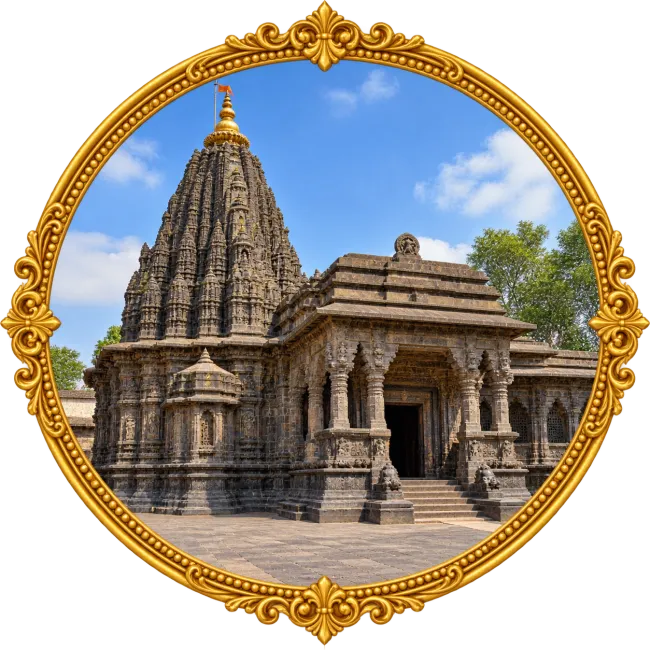
Mahalaxmi Temple, Kolhapur
Visit Mahalaxmi Temple in Kolhapur, one of Maharashtra’s most sacred and historically significant temples dedicated to Goddess Mahalaxmi. Also known as Ambabai Temple and Karveer Nivasini Mahalaxmi Temple, this ancient shrine is famous for its magnificent stone architecture, powerful spiritual traditions and the unique Kirnotsav festival.
About Mahalaxmi Temple, Kolhapur
Mahalaxmi Temple is located in the heart of Kolhapur city in Maharashtra. The temple is dedicated to Goddess Mahalaxmi, who is locally worshipped as Ambabai and Karveer Nivasini, meaning the Goddess who resides in the sacred region of Karveer.
Goddess Mahalaxmi is worshipped as the divine source of health, prosperity, strength, peace and spiritual well-being. Unlike representations that focus only on material wealth, the form worshipped in Kolhapur is regarded as a powerful manifestation of Adi Shakti.
The temple is one of Maharashtra’s three-and-a-half major Shakti Peethas, together with Tulja Bhavani Temple in Tuljapur, Renuka Devi Temple at Mahur and Saptashrungi Temple near Nashik.
Kolhapur is also known as Karveer and Dakshin Kashi because of its ancient temples and religious importance.
When Was Mahalaxmi Temple Built?
The earliest stone structure of Mahalaxmi Temple is associated with the seventh century. The temple received several additions, renovations and architectural expansions during later centuries.
Much of the present temple complex was developed during the rule of the Shilahara kings in the twelfth century. Stone inscriptions from 1190 and 1218 record royal grants, worship arrangements and offerings made to Goddess Mahalaxmi.
The temple was further supported and restored by the Yadavas, Maratha rulers and the royal family of Kolhapur.
Who Built Mahalaxmi Temple?
The first major stone temple at this sacred location is traditionally credited to Chalukya King Karnadeva during the seventh century.
The Shilahara rulers later constructed and expanded major portions of the present temple during the twelfth century. They considered Goddess Mahalaxmi their presiding deity and recorded her blessings in their royal inscriptions.
The Yadavas of Devagiri and Maratha rulers also contributed to the temple’s restoration, maintenance and religious traditions.
History of Mahalaxmi Temple
The temple’s history spans more than a thousand years. The early Chalukya rulers are associated with its original stone construction, while the Shilahara dynasty significantly expanded the main sanctum and surrounding structures.
King Bhoja II of the Shilahara dynasty made important contributions to religious institutions in the Karveer region. An inscription dated 1190 records arrangements for regular worship and offerings to Goddess Mahalaxmi.
Another inscription dated 1218, from the reign of Yadava King Singhana II, records valuable jewellery and gifts offered to the Goddess.
The temple survived periods of political change and was repeatedly protected and restored by local rulers and devotees. Maratha rulers and the royal family of Kolhapur continued supporting the temple and its daily rituals.
Legend of Goddess Mahalaxmi and Kolhasura
According to the Karveer Mahatmya, a powerful demon named Kolhasura took control of the Karveer region and began troubling its inhabitants.
The gods and sages prayed to Goddess Mahalaxmi for protection. The Goddess appeared in a powerful form and defeated Kolhasura after a fierce battle.
Before his death, Kolhasura requested that the region be named after him. The Goddess accepted his request, and the place became known as Kolhapur.
After restoring peace, Goddess Mahalaxmi made Karveer her permanent abode. She therefore became known as Karveer Nivasini Mahalaxmi.
Idol of Goddess Mahalaxmi
The sacred idol of Goddess Mahalaxmi is carved from dark stone and stands approximately three feet tall. It is installed on a raised stone platform inside the main sanctum.
The four-armed Goddess holds:
- A Matulinga fruit
- A mace
- A shield
- A bowl or Panpatra
A crown featuring a five-headed serpent adorns the deity. A stone lion, representing the Goddess’s divine vehicle, is positioned behind the idol.
The idol faces west, which is an unusual feature in Indian temple architecture. This west-facing position makes the temple’s famous Kirnotsav possible.
Significance of Mahalaxmi Temple
Mahalaxmi Temple is an important centre of Shakti worship. Devotees pray to Goddess Ambabai for prosperity, courage, family well-being, health, peace and spiritual progress.
According to religious tradition, a pilgrimage to Tirumala Venkateswara Temple is considered complete after receiving the blessings of Goddess Mahalaxmi at Kolhapur.
The temple is also deeply connected with the religious and cultural identity of Kolhapur. Many families worship Ambabai as their Kuldevi and visit the temple before beginning important family ceremonies.
Mahalaxmi Temple as a Shakti Peetha
Mahalaxmi Temple is recognised as one of the three-and-a-half Shakti Peethas of Maharashtra. It is regarded as a complete Shakti Peetha and an important centre of Goddess worship.
The other major Shakti Peethas in Maharashtra are:
- Tulja Bhavani Temple, Tuljapur
- Renuka Devi Temple, Mahur
- Saptashrungi Devi Temple, Vani
The temple’s spiritual importance is described in the Karveer Mahatmya, Devi Mahatmya and other sacred traditions.
Architecture of Mahalaxmi Temple
The temple is constructed primarily from dark stone and displays the Chalukyan architectural style. The structure includes carved pillars, stone walls, ornate ceilings, several mandaps and a beautifully designed sanctum.
The main temple complex contains shrines dedicated to:
- Goddess Mahalaxmi
- Goddess Mahakali
- Goddess Mahasaraswati
- Lord Ganesha
- Lord Vishnu
- Lord Shiva
- Lord Dattatreya
- Lord Venkateswara
- Navagrahas
- Other Hindu deities
The main sanctum is surrounded by stone pathways used for circumambulation. Intricate sculptures of deities, celestial beings, animals and floral patterns decorate the walls.
The temple’s alignment allows the setting sun to illuminate the deity during Kirnotsav.
Mahalaxmi Temple Timings
Darshan may be paused briefly during Mahabhishek, Maha Naivedya, decoration and other important rituals.
Timings may change during Navratri, Kirnotsav, Rathotsav, Lakshmi Puja, public holidays and special ceremonies.
Daily Puja and Rituals
Padhya Puja and Kakad Aarti
The temple doors open at 4:40 AM. Padhya Puja, Mukhamarjan and Kakad Aarti are performed from 4:45 AM to 5:30 AM.
Kakad Aarti is the first major worship of the day and symbolically awakens Goddess Mahalaxmi.
First Mahabhishek
The first Mahabhishek is performed at 9:00 AM. It is followed by Aarti and the distribution of Shankh Tirth.
Second Mahabhishek and Maha Naivedya
The second Mahabhishek is conducted at 12:00 PM. Aarti, Maha Naivedya and Shankh Tirth form part of this worship.
Salankrut Puja
After the midday rituals, Goddess Mahalaxmi is decorated with valuable ornaments, flowers and traditional clothing. This beautifully adorned form is known as Salankrut Darshan.
Evening Aarti
The evening Aarti is performed at 8:15 PM. Shankh Tirth is offered after the worship, and the ornaments used for Salankrut Puja are subsequently removed.
Shej Aarti
Shej Aarti is performed at 10:10 PM. It is the final major ritual and symbolically prepares the Goddess for rest. The temple doors close at 10:30 PM.
Special Pujas and Sevas
Devotees may arrange different pujas and devotional services according to temple regulations, including:
- Abhishek Puja
- Kumkum Archana
- Oti Bharan
- Saree Offering
- Maha Naivedya Seva
- Alankar Seva
- Deepdan
- Annadan
- Navratri Special Puja
- Lakshmi Puja
- Family Sankalp Puja
Personal Abhishek rituals are generally performed on the Utsav Murti or silver Padukas in the designated Abhishek Mandap rather than directly on the principal idol.
Puja bookings should be made only through authorised counters or recognised hereditary priests.
Dress Code for Abhishek Puja
General darshan does not require a complicated dress code, but visitors should wear clean and modest clothing.
Men participating directly in certain Abhishek rituals may be required to wear a dhoti. Women and other family members can participate through Sankalp while the appointed priest performs the ritual.
Dress and participation rules should be confirmed while booking the puja.
Kirnotsav at Mahalaxmi Temple
Kirnotsav is the temple’s most distinctive annual event. During this festival, the rays of the setting sun enter through the western doorway and fall directly on the idol of Goddess Mahalaxmi.
The phenomenon is traditionally observed from 31 January to 2 February and from 9 November to 11 November.
The sunlight falls on different parts of the deity over three days:
The exact visibility depends on weather conditions and the uninterrupted passage of sunlight. The annual Kirnotsav programme should be confirmed before visiting.
Major Festivals Celebrated
Sharadiya Navratri
Navratri is the most important festival celebrated at Mahalaxmi Temple. The Goddess is decorated in different forms, and special pujas, processions, cultural programmes and devotional performances are organised.
Kirnotsav
Kirnotsav celebrates the temple’s astronomical alignment with the setting sun. Thousands of devotees gather to witness the sunlight illuminate the sacred idol.
Rathotsav
During Rathotsav, the Utsav Murti of Goddess Mahalaxmi is placed in a decorated chariot and taken in a ceremonial procession.
Lalita Panchami
A special procession is organised on Lalita Panchami. The festival is associated with the Goddess’s traditional visit to Temblai Devi.
Lakshmi Puja
Special worship is performed during Diwali and Lakshmi Puja. The temple is decorated with lamps, flowers and ornaments.
Gudi Padwa
The Maharashtrian New Year is celebrated with special puja, decorations and devotional rituals.
Dussehra
Dussehra is observed with ceremonial worship and traditions connected with the royal family of Kolhapur.
Offerings at Mahalaxmi Temple
Devotees commonly offer:
- Kumkum and turmeric
- Lotus and other flowers
- Flower garlands
- Saree and blouse cloth
- Green bangles
- Coconut
- Fruits and sweets
- Oti material
- Lamps and incense
- Gold or silver ornaments through authorised facilities
- Donations for Annadan
Only approved offerings should be taken inside the temple.
Prasad at Mahalaxmi Temple
Laddoo, peda, coconut, kumkum and other forms of prasad are available near the temple.
Devotees should purchase prasad from authorised counters or reliable shops. Food offered as Naivedya is distributed according to temple arrangements.
Dress Code for General Darshan
Visitors should wear modest clothing appropriate for a religious place. Traditional Indian clothing is preferred but is not compulsory for regular darshan.
Footwear must be removed before entering the temple. Large bags and restricted items should be deposited at designated counters.
Photography and Security Rules
Photography and videography are restricted inside the temple, particularly near the main sanctum.
Visitors must follow the instructions of security personnel. Mobile phones, cameras, large bags and other restricted items may need to be deposited outside.
Security checks are conducted at the entrance, especially during festivals and crowded periods.
Best Time to Visit Mahalaxmi Temple
The best months to visit Kolhapur are from October to February, when the weather is pleasant.
For a peaceful darshan, visitors should arrive between 5:30 AM and 8:00 AM on a regular weekday. The afternoon period from 1:30 PM to 4:30 PM may also have comparatively shorter queues.
Navratri, Kirnotsav, Fridays, weekends and public holidays generally attract larger crowds.
Recommended Visit Duration
A regular temple visit requires one to two hours, depending on the queue.
Visitors participating in Abhishek Puja or planning to explore all the smaller shrines should reserve three hours.
During Navratri, Kirnotsav and Rathotsav, waiting periods may be significantly longer.
Entry Fee and Darshan Facility
General entry and regular darshan are free.
Paid pujas, Abhishek services and special devotional offerings may be available. Bookings should be made only through authorised temple facilities.
Devotees should obtain receipts for all payments and avoid private agents promising unauthorised VIP darshan.
How to Reach Mahalaxmi Temple, Kolhapur
By Air
Kolhapur Airport, also known as Chhatrapati Rajaram Maharaj Airport, is approximately 9 kilometres from the temple.
Taxis and local transport are available from the airport. Flight schedules should be checked before planning the journey.
Pune and Goa airports are additional options for visitors travelling from distant locations.
By Train
Chhatrapati Shahu Maharaj Terminus is the main railway station in Kolhapur and is approximately 3 kilometres from the temple.
The station has connections with Mumbai, Pune, Miraj, Sangli, Bengaluru and other major cities. Auto-rickshaws, taxis and local buses are available outside the station.
By Road
Kolhapur is well connected by road with Pune, Mumbai, Sangli, Satara, Belagavi, Bengaluru and Goa.
The Central Bus Stand is approximately 3 kilometres from the temple. State transport buses, private buses, taxis and auto-rickshaws are readily available.
Nearby Places to Visit
Bhavani Mandap
Bhavani Mandap is a historic royal structure located close to Mahalaxmi Temple. It once served as an important court and administrative centre of the Kolhapur rulers.
Rankala Lake
Rankala Lake is one of Kolhapur’s most popular recreational attractions. Visitors can enjoy the lakeside promenade, gardens and sunset views.
New Palace and Shahu Museum
The New Palace displays the royal heritage of Kolhapur. Its museum contains weapons, photographs, costumes, paintings and personal belongings of the royal family.
Jyotiba Temple
Jyotiba Temple is located approximately 18 kilometres from Kolhapur. The hilltop shrine is dedicated to Lord Jyotiba and is one of the region’s major pilgrimage sites.
Panhala Fort
Panhala Fort is approximately 20 kilometres from Kolhapur. It is associated with Chhatrapati Shivaji Maharaj and Maratha history.
Kaneri Math
Kaneri Math, also known as Siddhagiri Math, is a spiritual and cultural destination displaying traditional rural life and Indian heritage.
Temblai Devi Temple
Temblai Devi Temple is connected with Goddess Mahalaxmi and the Lalita Panchami procession.
Kopeshwar Temple
Kopeshwar Temple at Khidrapur is an ancient Shiva temple renowned for its remarkable stone carvings and distinctive circular Swarg Mandap.
Facilities Available
Facilities available in and around the temple include:
- General darshan queues
- Mukh Darshan arrangements
- Shoe-deposit counters
- Cloakrooms
- Drinking water
- Public toilets
- Prasad counters
- Puja-booking facilities
- Medical assistance
- Police and security services
- Parking areas
- Dharamshalas and hotels
- Vegetarian restaurants
- Local bus, taxi and auto-rickshaw services
Accommodation should be booked in advance during Navratri, Kirnotsav, weekends and public holidays.
Important Tips for Visitors
- Visit between 5:30 AM and 8:00 AM for peaceful darshan.
- Check the ritual schedule before joining the queue.
- Confirm Kirnotsav dates and weather conditions before travelling.
- Use only authorised puja and donation counters.
- Collect receipts for all paid services.
- Wear modest clothing.
- Carry a dhoti when participating in Abhishek Puja.
- Avoid carrying mobile phones, cameras and large bags.
- Follow the designated entry and exit routes.
- Do not photograph the sanctum or restricted areas.
- Keep additional time available during Fridays and festivals.
- Purchase prasad only from authorised counters.
- Avoid unauthorised guides and VIP-darshan agents.
- Maintain silence and cleanliness inside the temple.
Conclusion
Mahalaxmi Temple in Kolhapur is a magnificent combination of devotion, history, architecture and spiritual tradition. Its ancient stone structure, powerful form of Goddess Ambabai, position as a major Shakti Peetha and remarkable Kirnotsav make it one of Maharashtra’s most important pilgrimage destinations.
A visit to Karveer Nivasini Mahalaxmi Temple allows devotees to seek blessings for prosperity, strength, peace and spiritual well-being while experiencing the rich religious and cultural heritage of Kolhapur.